Zodiac Signs in Tamil: Names, Dates, and the Rasi Difference Explained
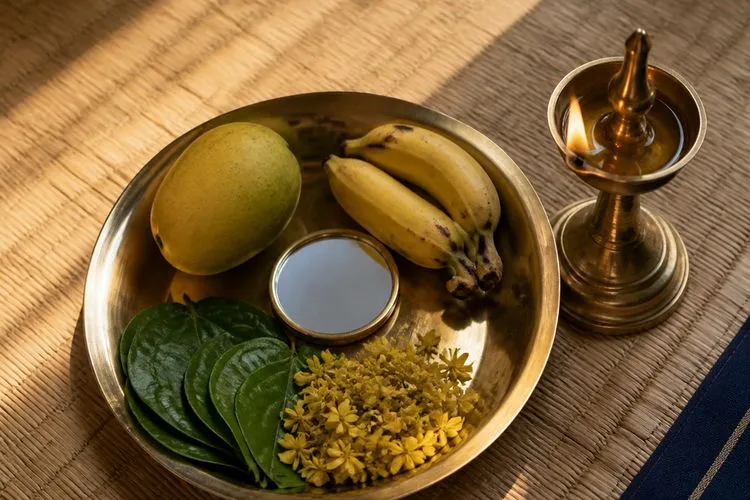
Two tabs can give you two different signs for the same birthday: a western site says Aries, while a Tamil source or family panchangam says Meenam or another rasi.
Both answers can be right inside their own systems because the systems are anchored to different things. Your confusion is not a mistake, and neither tradition needs to be dismissed.
I will show you the 12 Tamil names, explain the date shift through one April birthday, separate the two reasons signs can differ, and place natchathiram in the picture.
If you need a wider starting point, visit the site's zodiac basics.
The 12 Zodiac Signs in Tamil
These words name both the familiar western signs and the 12 traditional rasi in Vedic astrology. The word may stay the same while the applicable date range changes.
| Western sign | Tamil script | Romanization |
|---|---|---|
| Aries | மேஷம் | Mesham / Meṣam |
| Taurus | ரிஷபம் | Rishabam / Riṣabam |
| Gemini | மிதுனம் | Mithunam / Mitunam |
| Cancer | கடகம் | Kadagam / Kaṭakam |
| Leo | சிம்மம் | Simmam |
| Virgo | கன்னி | Kanni |
| Libra | துலாம் | Thulaam / Tulām |
| Scorpio | விருச்சிகம் | Viruchchigam |
| Sagittarius | தனுசு | Dhanusu / Danusu |
| Capricorn | மகரம் | Magaram |
| Aquarius | கும்பம் | Kumbam |
| Pisces | மீனம் | Meenam |
Romanization varies by source, as Mesham / Meṣam and Rishabam / Riṣabam show, but the Tamil words are consistent. They come from Sanskrit-derived roots shared across Tamil, Hindi, and Telugu rather than being unrelated names coined separately in each language. You can see all three languages side by side.
Two Anchors, One Sky: Why the Dates Don't Line Up
Western tropical astrology starts measuring its zodiac at the March equinox. That makes the beginning of Aries a seasonal reference point, even though the stars visible behind that point change slowly over long periods.
Sidereal astrology, used in Vedic and traditional Tamil contexts, measures the zodiac against the fixed-star background. It is looking at the same sky through a different reference frame. One system uses a season anchor; the other uses a star anchor.
Earth's rotational axis wobbles gradually through a process called axial precession. The resulting movement is about 50.3 arcseconds per year, or roughly 1 degree every 72 years. That slow movement causes the equinox-based and star-based starting points to drift apart.
The accumulated gap is called the ayanamsa. Under the Lahiri, or Chitrapaksha, ayanamsa, it is about 24 degrees as of 2026. In calendar terms, that produces about a 23-24-day difference because the Sun moves approximately 1 degree along the zodiac per day.
Lahiri is widely reported as the standard adopted in connection with India's National Panchang following the Calendar Reform Committee's work in 1955. I treat that as historical background, not as government endorsement of astrology or a rule that every family must follow. The current figure cited here comes from astrology-software references rather than a government or astronomical-institute source.
The everyday consequence is easy to recognize: a person's sidereal sun sign is typically one sign "behind" the western tropical sign. Someone whose tropical sun sign is Aries will often have the sidereal Sun in Meenam, or Pisces, though the exact birth date decides it.
I once had a Tamil name table open in one browser tab and a Mesha Sankranti date in another. One showed March 21, while the other pointed to April 14. I assumed one was a typo.
It was not. The first tab was applying a tropical date to a Tamil label, and the second was marking the sidereal Sun's entry into Mesham.
Neither anchor is more correct. They answer different questions within different symbolic systems. For the deeper astronomy behind this separation, read why zodiac signs don't match the constellations.
Worked Example: Mesha Sankranti, Puthandu, and the Mid-April Start
Take a birthday of April 2. A western tropical lookup returns Aries because tropical Aries runs from March 21 through April 19. A sidereal solar lookup gives a different result: on April 2, the Sun has not yet reached 0 degrees sidereal Mesham.
In 2026, that entry occurs at Mesha Sankranti on April 14. Under a traditional Tamil panchangam, the sidereal Sun on April 2 therefore remains in மீனம், Meenam, the preceding rasi.
Annotated April 2 example
- Western tropical result: Aries, because tropical Aries covers March 21-April 19.
- Sidereal solar result: Meenam, because the Sun does not enter sidereal Mesham until Mesha Sankranti on April 14, 2026.
- What creates the gap: An ayanamsa of about 24 degrees as of 2026, corresponding to about 23-24 days.
- Cultural check: The same star-based boundary explains why Puthandu begins in mid-April rather than at the March equinox.
- Honest limit: This example follows the Sun. It does not calculate Janma Rasi, which follows the Moon and requires birth time and place.
| Sign or comparison | Western tropical dates | Sidereal rasi dates (Vedic/Tamil) |
|---|---|---|
| மேஷம் Mesham / Aries | March 21-April 19 | About April 14-about May 14 |
| மீனம் Meenam / Pisces | February 19-March 20 | About March 14-about April 13 |
| ரிஷபம் Rishabam / Taurus | April 20-May 20 | About May 15-about June 14 |
| Reference anchor | March equinox and the seasons | Fixed-star background |
| What shifts or stays fixed | The star alignment gradually shifts relative to the seasonal dates | The star reference stays fixed while its civil-calendar dates shift gradually |
The sidereal spans are approximate, follow the Lahiri ayanamsa, and are anchored to 2026. Their boundaries can drift by roughly a day from year to year.
This is also why Puthandu, the traditional Tamil New Year, falls in mid-April rather than at the March equinox. The Tamil calendar year opens when the Sun enters sidereal Mesham at Mesha Sankranti. April 14 is specific to 2026; the ingress generally falls around April 13-14 and may differ by roughly a day in another year.
Myth vs Fact: When a Rasi Name Wears Western Dates
This is the part that tripped me up. A familiar Tamil name can be attached to either system, so the heading alone does not reveal which dates a page is using.
Myth: "My Tamil rasi is just the Tamil word for my zodiac sign, so the dates are the same."
Fact: The word is shared, but the date range is not necessarily shared. Genuine sidereal Mesham starts at Mesha Sankranti, about April 14 in 2026, rather than on March 21. The dates match only when a source has adopted the western tropical convention.
Myth: "This Tamil site says Mesham is March 21 to April 19, so that's the rasi date range."
Fact: March 21-April 19 is the western tropical Aries range wearing a Tamil label. It works as a translation of Aries, but it is not the sidereal Mesham boundary.
Myth: "One of the two systems must be wrong, and I need to find out which."
Fact: Neither system needs to be declared wrong. One is anchored to the equinox and the other to the fixed stars. The misleading practice is presenting one system's dates under the other system's terminology without disclosing the switch.
As of 2026, this undisclosed pattern appears in Tamil-facing "Mesham Rasi Palan" material on tamil.oneindia.com, tamildailycalendar.com, and astrosage.com's Tamil section. These pages show March 21-April 19 under the rasi name without identifying sidereal astrology, ayanamsa, or a panchangam. That does not make the Tamil translation illegitimate or the sites fraudulent.
It means the missing system label can leave readers with the wrong impression.
Public Quora threads contain user-generated accounts from people comparing real birth dates and receiving conflicting answers. Those low-authority discussions do not establish any astronomical or calendar fact, but they do show that the labeling problem confuses real readers. A related guide explains how the same mismatch plays out in Telugu.
The Second Reason: Your Rasi May Not Be a Sun Sign at All
Suppose you understand the 23-24-day tropical-sidereal offset and still cannot reconcile your family's rasi with a western sun-sign result. There may be another reason.
In everyday Tamil and Vedic usage, a person's rasi commonly means Janma Rasi, which is determined from the Moon's position at birth rather than the Sun's. Western popular astrology usually leads with the sun sign. The two systems may therefore be measuring different celestial bodies as well as using different zodiac anchors.
Keep those causes separate:
- Reference-frame difference: Tropical astrology is anchored to the equinox, while sidereal astrology is anchored to the fixed stars.
- Body difference: A western sun sign follows the Sun, while traditional Janma Rasi follows the Moon.
They are independent and additive. Mentally shifting a western date by about 23-24 days can illustrate a sidereal sun position, but it cannot reveal where the Moon was at the time of birth.
The larger roles of these chart components belong in what sun, Moon and rising actually mean. For this comparison, the practical limit matters most: a real Janma Rasi requires birth time and place. This page neither requests those details nor calculates a personal rasi.
Where Natchathiram Fits: The Layer Above the Rasi
The Tamil term natchathiram refers to nakshatram, commonly called a birth star. The traditional system has 27 nakshatras compared with 12 rasi. Dividing 27 by 12 gives roughly 2.25 nakshatras per rasi, making the birth-star layer finer than the sign layer.
That changes how the information functions in practice. In western popular astrology, people often treat the sun sign as the main identifying unit. In traditional Tamil practice, natchathiram commonly carries at least as much practical weight as rasi in naming customs and readings, and some accounts treat it as more consequential.
I am reporting that practice, not ranking one unit above another.
Porutham uses birth-star information in traditional marriage matching, but that separate system falls outside this article.
A natchathiram is Moon-based, so a simple date-only chart cannot identify it reliably. Birth time and place matter because the Moon moves through the birth-star divisions, and the relevant position must be calculated for the moment and location of birth. That is why a relative may ask for more than your birthday before discussing your rasi or natchathiram.
I find this layer useful because it explains why translating rasi as "zodiac sign" can feel incomplete. The words overlap, but the habits surrounding them do not map one-to-one.
How to Tell Which System a Page Is Using
Do not rely on the page title alone. Run these four checks on the source, app, calendar, or screenshot that gave you the puzzling answer.
Which system is this page using?
- Check the system label: Does it say tropical, sidereal, Vedic, ayanamsa, or panchangam anywhere?
- Check the Aries-equivalent boundary: Does Mesham or Aries start in late March, pointing to tropical dates, or in mid-April, pointing to sidereal dates?
- Check the requested birth details: Does it ask only for a date, or does it require birth time and place for a Moon-based result?
- Check the ayanamsa: If it claims to provide sidereal dates, does it identify which ayanamsa it follows?
If none of those questions is answered, treat the dates as a translation convenience rather than as a panchangam result.
Practice can vary by region and by ayanamsa choice. A family astrologer's panchangam may differ from these approximate dates by a day, and this explanation is not meant to overrule it.
I am a reader here, not a Vedic-astrology practitioner: I can explain the mechanism and show where the numbers come from, but I am not the person to declare what anyone's family panchangam should say.
I don't read daily horoscopes - I like the zodiac as a mirror, not a map.
Frequently Asked Questions
Why is my Tamil rasi different from my Western zodiac sign?
Two separate differences may be operating at once. The sidereal zodiac is shifted by about 23-24 days from the tropical zodiac as of 2026, and traditional Janma Rasi is usually based on the Moon rather than the Sun. Changing the reference frame does not resolve the separate Sun-versus-Moon difference.
Why does Tamil New Year fall in April and not in March?
Puthandu is tied to Mesha Sankranti, when the Sun enters sidereal Mesham, rather than to the March equinox. That entry generally falls around April 13-14 and occurs on April 14 in 2026. The exact civil-calendar date can drift by roughly a day from year to year.
What is the difference between rasi and natchathiram?
Rasi is one of 12 signs, while natchathiram, or nakshatram, is one of 27 birth stars. Each rasi therefore spans roughly 2.25 nakshatras. In traditional Tamil practice, the finer birth-star unit is often treated as at least as consequential as the rasi.
Can I find my rasi and natchathiram from just my date of birth?
No, not in the traditional Moon-based sense. A birth date can support an approximate sidereal sun-sign lookup, but Janma Rasi and natchathiram depend on the Moon's position and require birth time and place. This page does not calculate either personal result.
If a Tamil site lists Mesham as March 21 to April 19, is it wrong?
Not if the page is using Mesham as the Tamil translation of western tropical Aries. Those are tropical dates, however, not the traditional sidereal Mesham boundaries. The problem is missing disclosure: readers may reasonably assume that a page labeled "rasi" is presenting sidereal dates.
Take the page or app that first gave you a conflicting sign and run the four checks: system label, Mesham start date, required birth details, and named ayanamsa. If you also want the neighboring name sets, see all three languages side by side.
Sources
- AstroVed, "Zodiac Signs Names in Tamil" - Tamil script and romanization, cross-checked against five additional Tamil name lists, as of 2026.
- Universe Today, "Precession of the Equinoxes" - axial precession and its approximate rate, as of 2026.
- Jagannatha Hora, "Lahiri Ayanamsa Value" - about 24 degrees as of January 1, 2026; an astrology-software reference, not a government or astronomical-institute source.
- RoxyAPI, "Ayanamsa: Lahiri, Raman, KP for developers" - independent corroboration of the approximate Lahiri figure, as of 2026.
- GaneshaSpeaks Festival Calendar, "Mesha Sankranti" - April 14 date for Mesha Sankranti in 2026.
- IndiaTV News, "Mesh Sankranti 2026" - independent confirmation of the April 14, 2026 date.
- Astroyogi, "Sun Sign vs Rashi" - the traditionally Moon-based Janma Rasi convention, as of 2026.
- Documented content pattern across tamil.oneindia.com, tamildailycalendar.com, and astrosage.com's Tamil section - western dates printed under Tamil rasi labels without sidereal disclosure, observed as of 2026.
The zodiac described here, in either system, is a symbolic tradition for entertainment and self-reflection, not a scientific description or prediction about any person. Tropical and sidereal astrology use different reference frames; this page does not declare either one more correct. Ayanamsa values and sidereal date spans are approximate and dated to 2026. This article does not calculate a personal Janma Rasi or natchathiram, which requires birth time and place.