Cardinal, Fixed and Mutable Meaning: Zodiac Modalities
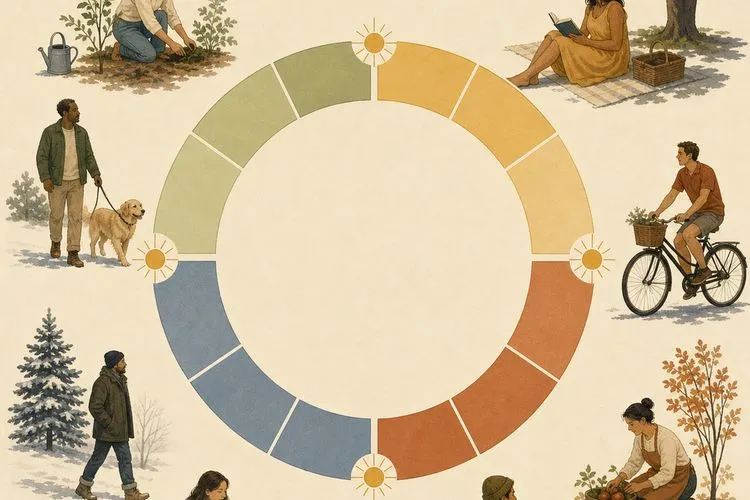
If horoscope copy keeps calling you "a fixed sign" and you have simply nodded along, you are not alone. I did that for years without asking what the phrase meant.
The useful translation is only three words: starts, holds, ends.
This page will help you name your sign's modality and the other signs in its group, read the season clock from four calendar anchors, and find your sign's element-modality formula.
For the larger framework, start with zodiac basics.
What Is a Modality? (And Why "Quality" Means the Same Thing)
A modality is the role a sign plays in its season. Cardinal starts the season, fixed holds it at full strength, and mutable closes it before handing the calendar to the next season.
"Modality" is the dominant US term as of 2026. "Quality" is an older term that still appears on legacy portals such as Cafe Astrology and even in Almanac.com's table headings.
An older book once gave me "qualities" while nearly every modern site gave me "modalities"; confirming that they meant the same axis took an evening I can save you. "Quadruplicity" is the older textbook word for a four-sign group (element groups are called triplicities; see the four elements explained).
In the tropical system, the arithmetic is tidy: 3 modalities x 4 signs = 12 signs. The cardinal-fixed-mutable sequence repeats four times around the wheel, and every modality includes one fire, earth, air, and water sign. Elements divide the 12 signs into four groups of three, while modalities divide them into three groups of four.
That is why the group sizes differ.
| Modality | Four signs, one per element | Element mix | Season role | Role keyword |
|---|---|---|---|---|
| Cardinal | Aries, Cancer, Libra, Capricorn | Fire + water + air + earth | Starts the season at its anchor | Initiator |
| Fixed | Taurus, Leo, Scorpio, Aquarius | Earth + fire + water + air | Holds mid-season | Sustainer |
| Mutable | Gemini, Virgo, Sagittarius, Pisces | Air + earth + fire + water | Closes the season | Adaptor |
Element mix is listed in the signs' wheel order.
These modalities form one axis within the zodiac system in plain English. They describe positions in a repeating calendar pattern, not grades awarded to signs.
The Season Clock: Where the Three Modalities Come From
The modality axis is the tropical system's calendar. Four seasonal anchors generate the entire pattern for Northern Hemisphere readers:
- Aries starts spring at the March equinox.
- Cancer starts summer at the June solstice.
- Libra starts fall at the September equinox.
- Capricorn starts winter at the December solstice.
The sign at each anchor is cardinal. The next sign occupies the middle of that season and is fixed. The third closes the season and is mutable.
Then another cardinal sign begins the next seasonal arc. Start, middle, end: the same sequence runs four times through the year.
September 22 gives us a useful worked example. In this framework, the September equinox is the day the Sun enters Libra, so the seasonal anchor and Libra's first day refer to the same event. Libra begins fall and therefore occupies a cardinal position.
Explore the Season Clock
Tap or hover over a sign to see its season phase, modality, and four-sign group. Selecting one segment also highlights the same modality in the other three seasons, making the repetition visible.
The interaction runs in your browser. Nothing is stored or sent. The wheel shows months and seasonal phases, not exact sign boundaries; printed sign windows can shift by about one day between years.
South of the equator, the seasons run opposite, and a small number of tropical astrologers flip the frame there, treating Libra as the spring-equinox sign. The starts-holds-ends structure itself does not change.
Cardinal Signs: Aries, Cancer, Libra, Capricorn
The cardinal signs are Aries, Cancer, Libra, and Capricorn. Together they supply one sign from every element: Aries is fire, Cancer is water, Libra is air, and Capricorn is earth.
Each one sits at an equinox or solstice and opens a season. In the tradition's role language, this makes cardinal the initiator position: it starts the next seasonal arc and sets that arc in motion. The label describes where these four signs sit in the calendar sequence.
It does not promise that every person with one of these Sun signs will initiate every project.
Libra shows the structure clearly. It opens fall at the September equinox. Aries does the same for spring, Cancer for summer, and Capricorn for winter.
Four anchors produce four cardinal signs, with no ranking among them.
Fixed Signs: Taurus, Leo, Scorpio, Aquarius
The fixed signs are Taurus, Leo, Scorpio, and Aquarius. Their element membership also covers the full set: Taurus is earth, Leo is fire, Scorpio is water, and Aquarius is air.
Fixed signs occupy the middle of their respective seasons. They hold the seasonal arc after a cardinal sign has opened it and before a mutable sign closes it. "Sustainer" is the clean role word here.
Aquarius, for example, holds the middle portion of winter in the Northern-Hemisphere frame. Taurus holds spring, Leo holds summer, and Scorpio holds fall. That is the whole structural claim.
Descriptions that turn "fixed" into a personality judgment have moved beyond what the modality pattern itself tells us.
Mutable Signs: Gemini, Virgo, Sagittarius, Pisces
The mutable signs are Gemini, Virgo, Sagittarius, and Pisces. Gemini is air, Virgo is earth, Sagittarius is fire, and Pisces is water, so this group again contains one sign of every element.
Each mutable sign closes a season and prepares the handoff to the next cardinal sign. In the tradition's role language, mutable is the adaptor position. Pisces closes winter before Aries begins spring; Gemini closes spring before Cancer begins summer.
Virgo and Sagittarius perform the same calendar role at the ends of summer and fall.
This is where horoscope vocabulary can create more drama than the structure warrants. "Mutable energy" points back to an end-of-season, ready-for-change role. It is not a verdict about a person's reliability.
I keep the no-ranking rule firm: initiator, sustainer, and adaptor are roles, not value tiers. The tradition ranks none of them. Any page that declares one modality superior is adding adjectives the scheme does not contain.
How the Three Roles Show Up in Real Life
The roles are easier to feel than to define, so I use one ordinary situation: friends planning a weekend trip. These cards illustrate the sequence rather than predicting how anyone will behave. Each response gets the same afternoon handled competently.
Cardinal response: the starter
Someone proposes dates that evening and books the first workable option. This illustrates the initiator role associated with Aries, Cancer, Libra, and Capricorn.
Fixed response: the sustainer
Someone builds the itinerary, books the refundable room, and sees the packing list through to the end. This illustrates the sustainer role associated with Taurus, Leo, Scorpio, and Aquarius.
Mutable response: the adaptor
When the forecast turns, someone replans the afternoon around it without ceremony. This illustrates the adaptor role associated with Gemini, Virgo, Sagittarius, and Pisces.
No card wins. Starting, sustaining, and adapting are different parts of completing the same trip.
Element Meets Modality: The 12 Unique Formulas
Elements and modalities cross to create the system's 12 two-word formulas. The calculation is 4 elements x 3 modalities = 12 combinations, and no two signs share both coordinates. Gemini is the only mutable air sign; Capricorn is the only cardinal earth sign.
Find your element along the left edge of the grid, then locate your modality across the top. The cell where they meet contains your sign. Read the column and row together: "fixed fire" for Leo, for example, or "cardinal water" for Cancer.
| Element | Cardinal | Fixed | Mutable |
|---|---|---|---|
| Fire | Aries | Leo | Sagittarius |
| Earth | Capricorn | Taurus | Virgo |
| Air | Libra | Aquarius | Gemini |
| Water | Cancer | Scorpio | Pisces |
Data as of 2026. Each sign appears exactly once - no two signs share both element and modality.
The grid teaches position, not personality. If the element half is still unfamiliar, read the four elements explained for that axis rather than trying to infer it from the modality label.
A Worked Example: Reading One Cell of the Grid
Here is Pisces read from the calendar through to its unique grid cell:
- Season position: Pisces closes winter, in the stretch before the March equinox hands the year to Aries.
- Modality: Closing the season places Pisces in the mutable column.
- Role: The tradition's role word for mutable is adaptor.
- Element: Pisces occupies the water row.
- Group: Its modality group is Gemini, Virgo, Sagittarius, and Pisces, one sign per element.
- Formula: The row and column combine as mutable water.
- Unique cell: Pisces is the only mutable water sign in the grid.
That same lookup works for every sign. You need only one row and one column (which is much less mystical than the vocabulary initially makes it sound).
Frequently Asked Questions
Is modality the same thing as quality in astrology?
Yes.
They are two names for the cardinal-fixed-mutable axis. "Quality" is the older US term and still appears on legacy portals such as Cafe Astrology as of 2026, while "modality" is now dominant. "Quadruplicity" refers to those same three four-sign groups.
What does it mean if my sign is cardinal?
Your sign sits at a season's opening anchor. Aries aligns with the March equinox, Cancer with the June solstice, Libra with the September equinox, and Capricorn with the December solstice. In the tradition's role language, cardinal initiates; that is a calendar role, not a rank or personality verdict.
My horoscope keeps mentioning "mutable energy" - what is it actually talking about?
"Mutable" names Gemini, Virgo, Sagittarius, and Pisces, the four signs that close their seasons. Horoscope copy borrows the end-of-season, ready-for-change role without always defining it. I am decoding that vocabulary here, not making a forecast about you or your week.
Is one modality better than the others?
No. Initiator, sustainer, and adaptor are roles rather than value tiers, and the scheme itself ranks nothing. A page that crowns a best modality is adding its own editorial judgment to a calendar pattern that contains no such ranking.
Does the season clock work the same in the Southern Hemisphere?
The familiar season names use a Northern-Hemisphere frame, with Aries marking spring. South of the equator, seasons run opposite, and a small number of tropical astrologers flip the frame so Libra becomes the spring-equinox sign. The start-middle-end structure remains identical either way.
How do I combine my element and modality to get my sign's formula?
Find your sign in the 12-cell grid, then read its column and row together. Four elements crossed with three modalities produce 12 unique combinations, with no pair repeated. Gemini gives "mutable air," for example, while Capricorn gives "cardinal earth."
Find Your Sign's Element-Modality Formula
Return to the 12-cell grid, find your sign, and read its column plus row. Use the season-clock wheel to see why its modality lands there, then take the other axis deeper with the four elements explained.
Sources
- Almanac.com, "Zodiac Modalities Explained", modality groups, repetition, element distribution, and legacy "quality" wording, accessed August 2026.
- Yoga Journal, "What Cardinal, Fixed, and Mutable Signs Mean", season anchors, season phases, and the September 22 Libra example, accessed August 2026.
- Kelly Surtees, "Astrology Basics: Your Sign's Element, Mode and Ruling Planet" (2020), element-modality uniqueness, accessed August 2026.
- Wikipedia, "Zodiac" and Encyclopaedia Britannica, "Zodiac", full sign, element, and modality tables used to verify the grid, accessed August 2026.
- Wikipedia, "Sun sign astrology", yearly variation in printed sign windows, accessed August 2026.
I don't read daily horoscopes - I like the zodiac as a mirror, not a map. The zodiac described here is a symbolic tradition for entertainment and self-reflection, never a scientific description of any person; sign language is a prompt, not a verdict.