Zodiac Sign Names in Hindi, Tamil, and Telugu
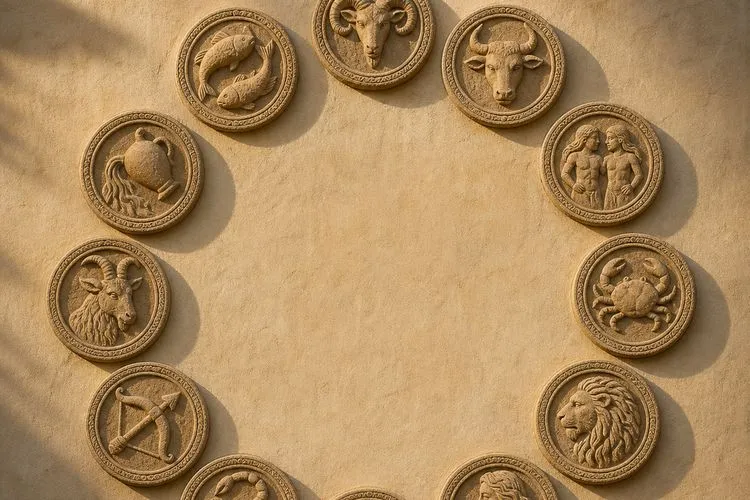
Here's your sign's name in Hindi, Tamil, and Telugu, script and all.
This table gives you the names for the twelve western tropical zodiac signs as they are written in each language, cross-checked against multiple independent sources.
It's a lookup for words, not personality content, and it will not calculate your rashi or nakshatra. That needs birth time and place, which this page does not collect.
For everything else, the table and the one honest thing below it are what you came for.
For context: this is part of the zodiac basics section of the site.
All 12 Sign Names in Hindi, Tamil, and Telugu
These are the names of the twelve western tropical signs as written in each language, with a common romanization:
| Western sign | Hindi (Devanagari) | Tamil | Telugu |
|---|---|---|---|
| Aries | मेष - Mesh / Mesha | மேஷம் - Mesham / Meṣam | మేషం - Mēṣaṁ / Meshaṁ |
| Taurus | वृषभ - Vrishabh / Vrishabha | ரிஷபம் - Rishabam / Riṣabam | వృషభం - Vṛṣabhaṁ |
| Gemini | मिथुन - Mithun / Mithuna | மிதுனம் - Mithunam / Mitunam | మిథునం (also మిధునం) - Mithunaṁ |
| Cancer | कर्क - Kark / Karka | கடகம் - Kadagam / Kaṭakam | కర్కాటకం - Karkāṭakaṁ |
| Leo | सिंह - Singh / Simha | சிம்மம் - Simmam | సింహం - Siṁhaṁ |
| Virgo | कन्या - Kanya | கன்னி - Kanni | కన్య / కన్యా - Kanya / Kanyā |
| Libra | तुला - Tula | துலாம் - Thulaam / Tulām | తుల / తులా - Tula / Tulā |
| Scorpio | वृश्चिक - Vrishchik / Vrishchika | விருச்சிகம் - Viruchchigam | వృశ్చికం - Vṛścikaṁ |
| Sagittarius | धनु - Dhanu | தனுசு - Dhanusu / Danusu | ధనుస్సు - Dhanussu |
| Capricorn | मकर - Makar / Makara | மகரம் - Magaram | మకరం - Makaraṁ |
| Aquarius | कुंभ - Kumbh / Kumbha | கும்பம் - Kumbam | కుంభం - Kumbhaṁ |
| Pisces | मीन - Meen / Meena | மீனம் - Meenam | మీనం / మీనము - Mīnaṁ / Mīnamu |
You can use it in both directions. Find your western sign in the first column and read across for the word. Or find a rashi word you saw somewhere in the other columns and read back to its western label.
The date question is answered in the next section, and if you want the western date windows and individual sign pages, the twelve western sign pages carry those.
One Honest Thing About These Names
The table translates the names used by western tropical astrology.
In Hindi, Tamil and Telugu-speaking practice, those same words are the twelve rashis or rasis of Vedic (sidereal) astrology, which anchors the zodiac to the fixed stars rather than to the March equinox.
The same word covers a date window that runs about 23 to 24 days later.
Here's the contrast for one sign:
| What you are reading | System it belongs to | When Aries / मेष / மேஷம் / మేషం runs |
|---|---|---|
| A western horoscope or a name-translation page | Western tropical, anchored to the March equinox | March 21 to April 19 |
| A traditional panchangam or a rashi phalalu column | Vedic sidereal, anchored to the fixed stars | Opens around April 14 in 2026 (Mesha Sankranti) and runs to roughly mid-May |
| The gap between them | The two reference frames have drifted apart | About 23 to 24 days, and it shifts slowly over time |
The April 14 date is the 2026 date and moves by about a day from year to year. Neither row is the "correct" one - they are two different reference frames.
Mesha Sankranti is the day the Sun enters sidereal Mesha. Several Indian regional calendars keep it as the solar new year: Puthandu, Vishu, Baisakhi, Naba Barsha. A different anchor point, a different date.
This page works in the western tropical system and says so. It does not rank the two.
If you want the full explanation for your language, here it is: the full Hindi rashi explanation, the full Tamil rasi explanation, the full Telugu rashi explanation.
Why the Three Languages Use Almost the Same Words
The twelve names are Sanskrit-derived astrological terms shared across most Indian languages, not three independent inventions that happen to line up. Look at a few triplets from the table: मेष / மேஷம் / మేషం (Aries), मकर / மகரம் / మకరం (Capricorn), कन्या / கன்னி / కన్య (Virgo). The root is stable.
The ending shifts with each language's phonology: Hindi's bare stem, Tamil's -am, Telugu's -aṁ.
What this means practically: if you know one of the three, the other two are usually recognizable. The words are tatsama - borrowed whole from Sanskrit and adapted to the sound patterns of each language. This is why vocabulary pages can list them side by side without much explanation.
The shared terminology is also why the tropical-sidereal date question matters across all three. A word that traveled from Sanskrit carries centuries of usage in traditional panchangam practice, where it refers to a sidereal window. When a modern reference page pairs that same word with the western tropical March 21 - April 19 window, the reader gets no signal that two systems are at work.
Why the Spelling Changes From Site to Site
The script is consistent across every source I checked. The Devanagari, Tamil and Telugu spellings do not vary. The romanization does: Mesh vs. Mesha, Mesham vs. Meṣam, Rishabam vs. Riṣabam, Kanya vs. Kanyā.
There is no single official transliteration standard in popular use. Diacritic-marked academic romanization and plain-letter everyday romanization coexist, and both are normal. For writing to family, copy the script column.
For writing in English, either romanization is fine, and pick the plainer one unless the person you are writing to uses diacritics.
Telugu sources also record a few spelling variants within the script itself: మిథునం / మిధునం (Gemini), కన్య / కన్యా (Virgo), తుల / తులా (Libra), మీనం / మీనము (Pisces). This is normal variation, not error. Language carries options, and both forms appear in careful reference material.
Myth vs Fact: What This Table Does and Doesn't Tell You
I went looking for these words myself a while back and found page after page pairing them with western date ranges, no note anywhere. The problem only surfaced when a panchangam-based source gave a completely different window for the same word. That's the origin of this section.
Myth: मेष is just the Hindi word for Aries, so it means the same dates.
Fact: The word is the right translation of the name. The dates only match if the source is using the western tropical calendar under a Sanskrit label. A traditional panchangam puts that same rashi about 23 to 24 days later, opening around mid-April.
Myth: If a page lists the rashi names with dates, it must be doing Vedic astrology.
Fact: Not necessarily, and this is worth checking. Vocabulary, translation and general-reference pages routinely print the western tropical ranges beside the rashi names with no mention of sidereal astrology anywhere. Dedicated panchangam and rashi-phalalu sources give the mid-April boundary instead.
Same words, two different classes of page. I compared the two sets while building the table, and the difference is consistent.
Myth: So one of the two systems is wrong.
Fact: Neither. They are anchored to different things - one to the March equinox, one to the fixed stars - and each is internally consistent. This site works in the western tropical system and says so.
It does not rank the two.
Where to Go Deeper
For Hindi speakers: the full Hindi rashi explanation tells you why a rashi date and a western sign date disagree, and where the roughly 23 to 24 day gap comes from.
For Tamil speakers: the full Tamil rasi explanation covers the same gap, plus the nakshatra layer and why Tamil New Year falls in April rather than at the March equinox.
For Telugu speakers: the full Telugu rashi explanation handles the gap and explains why even "the sidereal date" is not perfectly singular across panchangams - different ayanamsa conventions produce slightly different boundaries.
Frequently Asked Questions
Are the Hindi, Tamil, and Telugu names for the zodiac signs the same?
Nearly. All three use the same Sanskrit-derived roots, so the words are recognizable across languages. What changes is the ending and the script: मेष / மேஷம் / మేషం.
What is my Rashi in English?
Find the word in the table and read across to the western sign column. One caveat: the name matches, but the date window a traditional panchangam uses does not.
For the full story, see the full Hindi rashi explanation, the full Tamil rasi explanation, or the full Telugu rashi explanation, depending on which language you are working with.
Why don't the dates for my rashi match my western zodiac sign?
Because the two systems are anchored to different reference points, so the same-named window falls about 23 to 24 days later in the sidereal system. The full explanation is on the Hindi, Tamil and Telugu pages linked just above.
Is my rashi the same thing as my sun sign?
Often not. In everyday Indian usage, "rashi" most commonly means the Moon sign at birth, not the Sun sign western astrology uses. That's a second, separate reason the two labels can differ.
Each of the three language pages explains this layer in more detail.
Which spelling should I use if I want to write my sign's name in English letters?
Either one in the table. There is no single official transliteration standard in popular use. Diacritic and plain-letter spellings are both normal.
When it matters, copy the script.
Can this page tell me my Vedic rashi?
No, and no page working from a birth date alone can. A real rashi calculation needs birth time and place, and the traditional one is Moon-based. This table gives you the words, not a reading.
Now that you have your word and you know the dates can differ, open the page for your language and get the whole story: the full Hindi rashi explanation, the full Tamil rasi explanation, or the full Telugu rashi explanation.
Sources
- Cross-verified Hindi name list - Shikshanation, "Rashi Names in English and Hindi" - https://shikshanation.com/blog/rashi-name/ - as of 2026.
- Cross-verified Tamil name list - AstroVed, "Zodiac Signs Names in Tamil" - https://www.astroved.com/articles/zodiac-signs-names-in-tamil - as of 2026.
- Cross-verified Telugu name list - Talkpal.ai, "What Are the Names of Zodiac Signs and Astrology Terms in Telugu?" and Wikibooks, Telugu/Zodiac Signs - https://talkpal.ai/culture/what-are-the-names-of-zodiac-signs-and-astrology-terms-in-telugu/ and https://en.wikibooks.org/wiki/Telugu/Zodiac_Signs - as of 2026.
- RoxyAPI, "Ayanamsa Explained" (tropical vs. sidereal reference-frame difference and approximate offset) - https://roxyapi.com/blogs/ayanamsa-lahiri-raman-kp-developers - as of 2026.
- GaneshaSpeaks festival calendar, "Mesha Sankranti" (Mesha Sankranti 2026 = April 14) - https://www.ganeshaspeaks.com/festival-calendars/information/mesha-sankranti/ - as of 2026-04-14.
The zodiac described here is a symbolic tradition for entertainment and self-reflection - never a scientific description of any person, and never a prediction about a specific individual.