Western vs. Chinese Zodiac: Why These Are Two Completely Different Systems
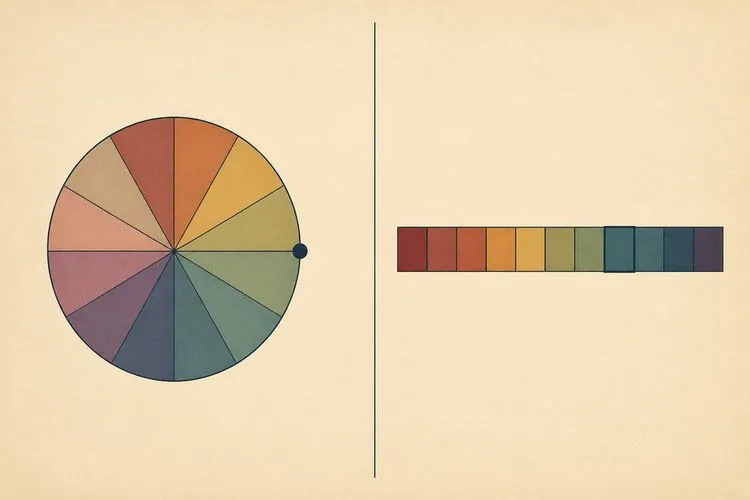
The Western sun sign and Chinese zodiac animal are not connected, and there is no Chinese animal that automatically goes with your star sign.
If you have seen a page pairing your sign with a Chinese zodiac animal, here is why that pairing is not meaningful.
The confusion is reasonable: both systems have twelve categories, and English uses the word "zodiac" for both.
I will put their mechanisms side by side, explain why they cannot be joined, and show you how to recognize invented pairing tables. You can also explore the rest of zodiac basics.
The Short Answer: Different Inputs, So Nothing to Convert
A Western sun sign uses your birth month and day. A Chinese zodiac animal uses your birth year, with Lunar New Year determining where that year begins.
Because the two systems take different inputs, there is no conversion, equivalence, or corresponding animal. This is not a disagreement between competing interpretations. It is arithmetic: knowing someone's position within one solar year does not tell you which year in a repeating twelve-year cycle they were born.
Both systems happen to use twelve categories. That shared count does not connect them any more than a twelve-month calendar connects automatically to a twelve-item list. The mechanisms below let you check that reasoning yourself instead of taking my verdict on trust.
How the Western Sun Sign Works: One Year, Twelve Slices
In the Western tropical system, one solar year is divided into twelve roughly equal segments of about 30 days each. The segment the Sun occupied on your birth date gives your sun sign, so the needed input is your birth month and day. Your birth year does not change that answer.
That is the whole recap. For the fuller version, including what "sun sign" means in this context, see how the Western tropical system actually works.
The sign names do not line up neatly with the astronomical constellations, either. That is a separate issue, covered in why Western signs don't match the constellations either.
How the Chinese Zodiac Works: Twelve Years, One Animal Each
The Chinese zodiac uses a repeating twelve-year cycle, not twelve divisions within one year. Each calendar year in the Chinese lunar calendar carries one animal sign, and a person's animal is set by the year of birth.
The twelve animals, in order, are Rat, Ox, Tiger, Rabbit, Dragon, Snake, Horse, Goat, Monkey, Rooster, Dog, and Pig. Goat may also be translated as Sheep or Ram; those names reflect a translation difference from the Chinese source term rather than separate positions in the cycle.
The boundary readers most often miss is the start of the year. The Chinese zodiac year begins at Lunar New Year, not January 1. Lunar New Year falls between January 21 and February 20, and its date moves annually.
Someone born in January or early February may therefore belong to either the current calendar year's animal or the previous animal year, depending on that year's boundary.
For one dated illustration, 2026 is the Year of the Horse from February 17, 2026, through February 5, 2027. That example shows why a calendar year alone is not enough near the boundary; the exact Lunar New Year date matters.
This is as far as I take the mechanism here. I write about the Western system, and I would rather draw an accurate boundary than turn someone else's tradition into a thin lookup feature.
Side by Side: What Each System Actually Uses
| Question | Western sun sign | Chinese zodiac animal |
|---|---|---|
| What decides it? | Birth month and day | Birth year |
| What unit of time does it divide? | One solar year, cut into twelve slices | A repeating twelve-year cycle, with one animal per year |
| When does the period start? | At fixed calendar dates within the year | At Lunar New Year, which falls between January 21 and February 20 and moves every year |
| How many categories are there? | Twelve | Twelve |
| Does your birth year change the answer? | No | It is the whole answer |
| Does the other system's result affect it? | No | No |
The rows that matter are the input, unit of time, boundary date, and what changes the result. Western sun signs locate a date within one year; Chinese zodiac animals locate a birth year within a repeating cycle.
There is no shared input column. Nothing on one side supplies the information needed to calculate the other.
Why There's No "Chinese Equivalent" of Your Star Sign
Birth year and day of the year are independent facts about a person. Two people with the same Western sun sign can have been born years apart, while two people born in the same Chinese zodiac year can have birthdays in different Western sign periods.
From that alone, a fixed pairing cannot be derived. That is not a citation or a finding from a study; it is simply what follows from the two definitions. Any table that assigns one Chinese animal to each Western sign must have had those pairings chosen by an author.
If you arrived hoping to identify your own Chinese zodiac animal, the honest answer is that it depends on your birth year and, for a January or early-February birth, the date of Lunar New Year that year.
This page deliberately does not publish a lookup table. The site covers Western tropical astrology, and sending you into a half-built version of another tradition would be worse than declining to provide a shortcut.
I know that is less instantly satisfying than a neat answer. It is also more honest (and it keeps a boundary page from pretending to be an authority on the entire Chinese system).
The "Spirit Animal" Pairing Tables: Where They Come From
Across search results, a recognizable genre of page assigns every Western sign a Chinese zodiac animal. A typical claim might say that Gemini's Chinese zodiac "spirit animal" is the Horse, then justify the pairing through supposed similarities between personality descriptions.
No individual pairing page is being treated as a verified source here. I am describing a pattern visible across multiple independent search results, not quoting, naming, or linking a particular publisher.
My guess is that these pages attract two kinds of searches. One reader assumes a birth month selects a Chinese animal in the same way it selects a Western sign. Another is trying to find an actual birth-year animal but only has Western-sign language available.
That is my inference, not a study of reader behavior.
I once followed one of these tables looking for its provenance: a rule, calculation, cited tradition, anything that explained how the pairings were produced. There was nothing on the page to find. That failed hunt became the checklist below.
Myth vs. Fact
Myth: "Every Western sign has a matching Chinese zodiac animal."
Fact: The systems use different inputs: month and day in one, birth year in the other. There is nothing to match, so any fixed pairing was selected by its author rather than derived from either mechanism.
Myth: "Both have twelve, so they must line up."
Fact: Twelve slices within one solar year and twelve years within a repeating cycle are different objects that share a count. They could line up only if they measured the same thing, and they do not.
Myth: "My Chinese animal is set by my birthday, like my star sign."
Fact: It is set by birth year, with that animal year beginning at Lunar New Year. Because the boundary moves between January 21 and February 20, a January or early-February birth may sit on either side of it.
Red Flags: How to Recognize a Made-Up Pairing Page
- It never asks for a birth year. The page is missing the input the Chinese system actually uses.
- It gives no method. A pairing appears without a rule, calculation, or cited tradition explaining how anyone arrived at it.
- It relies on personality resemblance. Reasoning such as "both are restless, so they match" is a writer's comparison between descriptions, not a connection between systems.
- It uses January 1 as the boundary or ignores the boundary. The Chinese zodiac year starts at Lunar New Year, whose date moves annually.
One red flag is enough to pause. A page cannot calculate a birth-year category while refusing to ask for the year.
What to Do With This
Keep the distinction simple: Western sun signs use birth month and day; Chinese zodiac animals use birth year, adjusted around Lunar New Year. There is no bridge that converts one result into the other.
This page explains that boundary. It does not teach Chinese zodiac personality content, compatibility, or birth-year lookup, because that depth belongs with people who work within that tradition.
I do not read daily horoscopes. I like the zodiac as a mirror, not a map, and I apply that skepticism to both systems. They are symbolic traditions for entertainment and self-reflection, not scientific descriptions of people or tools for predicting what someone will do.
If you want the longer version of that distinction, read what any zodiac system can and can't tell you.
Frequently Asked Questions
Is my Chinese zodiac animal connected to my star sign?
No. Your Western sun sign comes from the month and day you were born, while your Chinese zodiac animal comes from your birth year. Those inputs do not convert into each other, so there is no matching animal. A page offering a fixed pairing has chosen it rather than calculated it.
I was born in early February - which animal year am I in?
It depends on the Lunar New Year date in your birth year. That boundary falls somewhere between January 21 and February 20 and moves annually, so an early-February birthday can fall on either side. This page deliberately does not publish the birth-year lookup, for the scope reasons explained earlier.
Why do so many sites pair my sign with a Chinese animal?
Because the format makes an easy page, not because the pairing follows from either system. These tables commonly rely on claimed personality resemblance and present the result as established fact. They do not provide a valid calculation connecting birth month and day to a birth-year cycle.
Both systems have twelve - doesn't that mean something?
It means both traditions use twelve categories, but it does not create a conversion. The Western system divides one solar year into twelve slices, while the Chinese zodiac follows a twelve-year cycle. A shared count does not make two systems measure the same information.
Which system is more accurate?
Neither, because accuracy in that predictive sense is not the right frame here. Both are traditional symbolic systems used for reflection and entertainment, not scientific descriptions of a specific person or reliable predictions about one. Rank the stories you find useful if you wish; do not rank the traditions.
Take this one-sentence test with you: if a page assigns a zodiac animal without asking what year you were born, it is making the answer up. For the system this site actually covers, continue with how the Western tropical system actually works.
Sources
- China Highlights, "Chinese Zodiac": twelve-year cycle, birth-year input, animal order, translation variants, and the Lunar New Year boundary. Accessed August 2026.
- TravelChinaGuide, "Chinese Zodiac": moving January 21 to February 20 boundary and the 2026 dated illustration. Accessed August 2026.
The pairing tables are an observed search-result pattern; no individual page was verified, cited, or linked. The suggested reasons people search for them are my inference, not a study.
The zodiac systems described here are symbolic traditions for entertainment and self-reflection, never scientific descriptions of, or predictions about, any person.