The Zodiac Wheel: How the 12 Signs, Elements and Modalities Fit Together
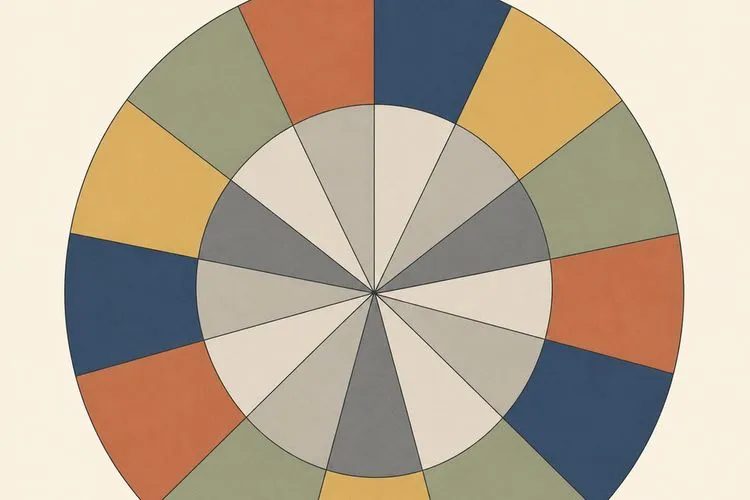
Picture the year as a circle instead of a list, and the whole system gets easier to hold in your head.
That's what this page is for: the spatial view of the zodiac, with a diagram you can actually read off. I'll show you three things here.
First, the twelve positions in order, with every sign's exact degree span. Second, the two bands that repeat around them - four elements cycling three times, three modalities cycling four times.
Third, a plain account of what this picture does and does not claim. No mysticism teaser, no forecast, no product pitch.
Just the wheel, its legend, and the geometry that makes it learnable.
What the Zodiac Wheel Actually Is
The zodiac wheel is a coordinate diagram: twelve equal sectors of exactly 30 degrees each, and 12 × 30 gives you the full 360 degrees of the ecliptic. Counting begins at 0° Aries - the March equinox point - and the circle runs Aries through Pisces from there.
A sector of this circle is called a sign, and a sign is not a constellation; those are two different systems, and I'll link that now so we can move on.
This is a filing system for a symbolic tradition, drawn as a circle because that's the shape it was built in. It's not a photograph of the sky.
The Twelve Positions in Order
Around the wheel the signs run: Aries, Taurus, Gemini, Cancer, Leo, Virgo, Libra, Scorpio, Sagittarius, Capricorn, Aquarius, Pisces. The arithmetic that makes any position locatable: position 1 spans 0-30°, position 2 spans 30-60°, and so on through position 12 at 330-360°.
The reference table below is the diagram's legend and its authority - if you see a wheel image somewhere else with no table beside it, you're looking at decoration, not a reference you can use.
| Position | Degrees from 0° Aries | Sign | Element | Modality |
|---|---|---|---|---|
| 1 | 0-30° | Aries | Fire | Cardinal |
| 2 | 30-60° | Taurus | Earth | Fixed |
| 3 | 60-90° | Gemini | Air | Mutable |
| 4 | 90-120° | Cancer | Water | Cardinal |
| 5 | 120-150° | Leo | Fire | Fixed |
| 6 | 150-180° | Virgo | Earth | Mutable |
| 7 | 180-210° | Libra | Air | Cardinal |
| 8 | 210-240° | Scorpio | Water | Fixed |
| 9 | 240-270° | Sagittarius | Fire | Mutable |
| 10 | 270-300° | Capricorn | Earth | Cardinal |
| 11 | 300-330° | Aquarius | Air | Fixed |
| 12 | 330-360° | Pisces | Water | Mutable |
These labels are traditional groupings, not measurements.
Four of those positions sit at the season boundaries: Aries at the March equinox (position 1), Cancer at the June solstice (position 4), Libra at the September equinox (position 7), Capricorn at the December solstice (position 10).
Evenly spaced, 90 degrees apart. The season-clock mechanism itself lives on a different page; here they're just anchors showing you the wheel's coordinate grid. For the full six-column master grid with dates and ruling planets, head to the sun-sign page - this table deliberately keeps only what the wheel encodes.
The Element Band: Four Colors, Three Times Around
Around the circle the elements run fire, earth, air, water, and then start again - a step of four positions, three complete cycles in twelve. What that buys you: signs of the same element sit four positions apart, evenly spaced around the circle, which is why the fire signs form a triangle rather than sitting in a block.
Fire: Aries, Leo, Sagittarius.
Earth: Taurus, Virgo, Capricorn.
Air: Gemini, Libra, Aquarius.
Water: Cancer, Scorpio, Pisces.
That's the grouping. Strengths, shadow sides, what your element supposedly says about you - all of that lives on the elements page, not here. This page carries element only as a position band with a legend.
The Modality Band: Three Roles, Four Times Around
Cardinal, fixed, mutable repeat on a step of three positions - four complete cycles in twelve. The spatial consequence: signs sharing a modality sit three positions apart, forming a square around the circle. And because 3 and 4 share no common factor, every modality group ends up holding one sign of each element.
Cardinal: Aries, Cancer, Libra, Capricorn.
Fixed: Taurus, Leo, Scorpio, Aquarius.
Mutable: Gemini, Virgo, Sagittarius, Pisces.
No role prose here, no initiator-sustainer-finisher characterizations. That season-clock derivation is a different page. The repeat-pattern table below compresses the whole article into three rows - this is why you can derive twelve labels instead of memorizing them.
| Pattern | Step around the wheel | Full cycles in 12 positions | Worked instance |
|---|---|---|---|
| Element band | every 4 positions | 3 | Aries (1) → Leo (5) → Sagittarius (9), all Fire |
| Modality band | every 3 positions | 4 | Aries (1) → Cancer (4) → Libra (7) → Capricorn (10), all Cardinal |
| Opposite axis | every 6 positions | 6 pairs | Aries (1) opposite Libra (7) |
What the Circle Shows That a List Can't
Overlay the two bands and you get this: a step of four and a step of three landing on the same twelve positions means no two signs can share both element and modality. 4 × 3 = 12 unique pairs, exactly filling the circle. Gemini is mutable air; Capricorn is cardinal earth.
Every other position gets its own combination, and that's a property of the circle, not a coincidence you memorize.
The second thing only the circle shows: every sign sits directly across from the sign six positions away, 180 degrees apart. Aries opposite Libra. Taurus opposite Scorpio.
Gemini opposite Sagittarius. Cancer opposite Capricorn. Leo opposite Aquarius.
Virgo opposite Pisces. That's pure geometry.
Any relationship reading - opposites attract, these two clash, whatever - is traditional symbolism that belongs to the compatibility pages, and it's never a verdict about two actual people.
Annotated example: Gemini, read end to end
- Locate the sign in the reference table → position 3, degrees 60-90°. (Column answered: Position and Degrees.)
- Count the element band. From position 3, count four forward and you land at position 7 (Libra); count four back and you land at position 11 (Aquarius). Gemini sits at 3. All three are Air. (Column answered: Element.)
- Count the modality band. From position 3, count three forward → position 6 (Virgo); three more → position 9 (Sagittarius); three more → position 12 (Pisces). All four, including Gemini, are Mutable. (Column answered: Modality.)
Read the pair as the sign's full label: mutable air. No other position on the circle produces that pair.
One-line second pass, so you see it generalize: Capricorn sits at position 10; count four back (10 → 6 → 2) and four forward (10 → 2 → 6) for Earth; count three in each direction (10 → 7 → 4 → 1, then 10 → 1 → 4 → 7) for Cardinal.
Cardinal earth. Done.
How to Read Any Sign's Position in Four Steps
Most decorative wheel images give you nothing you can read off. This procedure is what they can't give you. Once you count the repeat, you stop memorizing twelve separate facts and start deriving them.
Four-step reading procedure
- Find your sign's row in the reference table and read its position number.
- Read its degree span: position × 30, minus 30, to position × 30.
- Count four forward and four back for its element siblings - they sit at your position + 4 and your position - 4 (wrapping around the circle as needed).
- Count three forward and three back for its modality siblings - they sit at your position + 3 and your position - 3.
This tells you where a sign sits in the diagram and what the tradition labels it. It tells you nothing whatsoever about anyone's character, relationships or future.
I carried the twelve signs around as a flat alphabet for a long time and only stopped confusing them once I drew the circle and counted the bands. This page is that moment, written down.
What the Wheel Doesn't Tell You
What the wheel is: a coordinate diagram of a traditional symbolic system, useful for orientation and self-reflection.
What it's not: a map of the constellations (the signs don't line up with the star pictures), a scientific model, a prediction about anyone, a compatibility verdict, or a personality test.
Sign, element and modality labels are traditional descriptions for entertainment and self-reflection - never science, diagnosis or forecast. For the full evidence record, see what controlled testing has actually found.
One note for southern readers: the equinox and solstice anchors follow Northern Hemisphere convention, so the season labels (spring equinox at Aries, winter solstice at Capricorn) read backward below the equator.
The degree positions stay the same; only the season names flip.
Frequently Asked Questions
What order do the zodiac signs go in around the wheel?
Aries, Taurus, Gemini, Cancer, Leo, Virgo, Libra, Scorpio, Sagittarius, Capricorn, Aquarius, Pisces, running from 0° Aries. The reference table earlier in this article lists all twelve positions with their degree spans, element and modality.
Why does the wheel start with Aries instead of January?
The tropical wheel is anchored to the March equinox, not to the calendar year. 0° Aries is the equinox point, so the circle starts where the seasons do, not where January does.
How do I find my position on the wheel if I only know my birthday?
The wheel is keyed by sign, not by date.
Find your sun sign first - use the site's zodiac sign calculator or the master grid on the sun-sign page - then read that sign's row here.
Are the twelve sectors really all the same size?
Yes. In the tropical zodiac each sign is exactly 30 degrees; 12 × 30 = 360. The unequal bands you see in sky apps are constellations, which are a different thing entirely.
Does sitting opposite another sign on the wheel mean we clash?
Being six positions apart is a geometric fact about the circle, nothing more. Any relationship reading is traditional symbolism, belongs to the compatibility pages, and is never a verdict about two people.
How do I know I've actually understood the wheel?
You can name any sign's element and modality without looking, because you're counting the two repeats rather than recalling twelve separate facts. The four-step procedure earlier in this article is the test.
Now read the wheel the other way round - the full master grid, with dates and rulers. Or explore the rest of zodiac basics.
Sources
- Wikipedia, "Zodiac" - the 12 × 30-degree division of the ecliptic and the tropical anchor at the March equinox point. https://en.wikipedia.org/wiki/Zodiac (as of 2026-08).
- Almanac.com, "Every Zodiac Element Explained" and "Zodiac Modalities Explained" - the element and modality groupings and the repeating cardinal-fixed-mutable sequence around the wheel. https://www.almanac.com/zodiac-elements-fire-earth-air-water-explained and https://www.almanac.com/cardinal-fixed-mutable-cardinal-signs (as of 2026-08).
- Kelly Surtees, "Astrology Basics: Your Sign's Element, Mode and Ruling Planet" (2020) - the 4 × 3 = 12 unique element-modality pairs and the one-of-each-element rule inside every modality group. https://www.kellysastrology.com/2020/01/12/astrology-basics-your-signs-element-mode-and-ruling-planet (as of 2020-01).