Are Cusp Signs Real? What Being Born on the Cusp Means
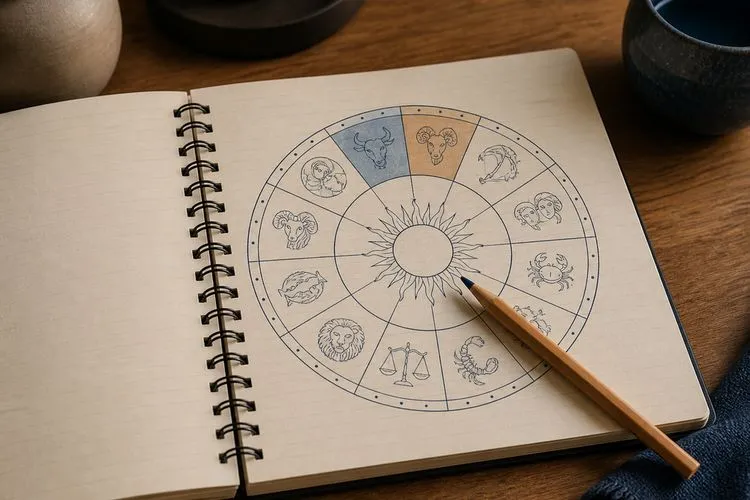
If you've called yourself a cusp your whole life, I'm not here to take that away from you.
I want to show you where the tradition came from, what your birth date actually says, and how to keep both without fudging a single date.
The short answer is simple, but the paper trail is surprisingly messy. We'll audit that lore, make sense of the feeling that both signs fit, and decide which sign's content to read.
The Short Answer: One Sun, One Sign, and One Real Edge Case
You have one sun sign, not two.
The Sun occupies exactly one sign at any moment, and astrologers Roya Buckland and Heather Roan Robbins have both rejected the idea that someone literally has two signs in published comments reported by TODAY.
There is one real edge case: the Sun changes signs on exactly 12 days each calendar year. Your birth year determines which of the usually two possible calendar dates was the switch day, and your birth time matters if you were born on that day.
Put in the required verdict form: in a given year the Sun entered the new sign on a specific date; born that day you are the new sign unless you were born before the switch moment, when the adjacent sign applies.
You can settle your boundary day by birth year instead of trying to average two generic date lists.
| The claim | What's actually true |
|---|---|
| Born on a cusp, you are two signs. | The Sun occupies exactly one sign at any moment. Roya Buckland and Heather Roan Robbins have said on the record that people do not actually have two sun signs. |
| Cusp dates are fixed, such as April 16-22 every year. | Each boundary occurs on one of usually two dates depending on the year. Publishers also contradict one another, and sometimes themselves, about the surrounding lore ranges. |
| Cusp dates come from ancient astronomy. | The familiar ranges trace to 20th-century newspaper horoscope practice, while the named-cusp canon has a modern birthday-book lineage. |
| The signs changed or NASA added a 13th sign, so cusps must matter now. | Precession shifts the constellation backdrop, not membership in the tropical zodiac. Read why sign dates move between years for the astronomy behind date changes. |
| If you don't feel like your sign, you must be a cusp. | Edge degrees and a planet in the neighboring sign are possible explanations within the tradition. Your identity can also be broader than a single label, even though sun-sign membership remains singular. |
What 'Cusp' Was Supposed to Mean: Degrees, the Solar Disc, and the 12-Hour Window
Each tropical zodiac sign occupies a 30-degree arc. The Sun appears to move about 1 degree per day, with daily ephemerides showing roughly 1 degree and 2 minutes between some consecutive positions. In the older degree-based sense, the last degrees of one sign and the first degrees of the next could be described as an edge or cusp.
That is much narrower than the week-long ranges printed on popular cusp pages.
There is also a physical image behind the language. The solar disc appears about half a degree wide. Around the instant its center crosses a sign boundary, the disc can straddle that boundary for about 12 hours, from roughly 29 degrees 30 minutes to 0 degrees 30 minutes.
The center still has one exact position, but the visible disc lies across the line for part of a day.
I find that distinction useful because it preserves what is interesting about the word without turning it into a seven-day membership zone. In the narrow visual sense, "on the cusp" describes an hours-scale event surrounding one ingress moment. In pop astrology, the same phrase became a multi-day label.
Those are not interchangeable claims. One concerns a disc crossing a mathematical boundary; the other assigns a themed identity to people born over several dates.
The Named Cusps, Kept as Tradition
The named cusps are real as a publishing tradition. They are not additional zodiac signs, and their date ranges do not determine membership.
The table below records the canon presented by Tarot.com's cusp pages, which state a basis in The Secret Language of Birthdays by Gary Goldschneider and Joost Elffers, with Rezek associated with the lineage cited in the research.
I observed these published ranges in August 2026.
Tradition, not membership: as published by Tarot.com's cusp pages, with a stated basis in The Secret Language of Birthdays, observed August 2026.
| Cusp name | Tradition's date range | Sign pair | One-line gloss |
|---|---|---|---|
| Cusp of Mystery | January 16-23 | Capricorn-Aquarius | "Mystery" frames the meeting of Capricorn and Aquarius as something difficult to pin down. |
| Cusp of Sensitivity | February 15-21 | Aquarius-Pisces | "Sensitivity" is the tradition's image for the Aquarius-Pisces pairing. |
| Cusp of Rebirth | March 17-23 | Pisces-Aries | "Rebirth" pictures the turn from Pisces to Aries as a fresh cycle. |
| Cusp of Power | April 16-22 | Aries-Taurus | "Power" is the canon's forceful label for the Aries-Taurus pairing. |
| Cusp of Energy | May 17-23 | Taurus-Gemini | "Energy" casts the Taurus-Gemini meeting as movement between their poles. |
| Cusp of Magic | June 17-23 | Gemini-Cancer | "Magic" supplies an enchanted image for the Gemini-Cancer pairing. |
| Cusp of Oscillation | July 19-25 | Cancer-Leo | "Oscillation" imagines a swing between Cancer's and Leo's poles. |
| Cusp of Exposure | August 19-25 | Leo-Virgo | "Exposure" evokes the transition between Leo and Virgo in the canon. |
| Cusp of Beauty | September 19-25 | Virgo-Libra | "Beauty" is the tradition's aesthetic frame for Virgo-Libra. |
| Cusp of Drama | October 19-25 | Libra-Scorpio | "Drama" gives the Libra-Scorpio pairing a theatrical title. |
| Cusp of Revolution | November 18-24 | Scorpio-Sagittarius | "Revolution" presents the Scorpio-Sagittarius pairing as a dramatic turn. |
| Cusp of Prophecy | December 18-24 | Sagittarius-Capricorn | "Prophecy" is the canon's forward-looking image for Sagittarius-Capricorn. |
The list starts on January 16 because it is printed calendar-first, not because Capricorn-Aquarius has astronomical priority. That small editorial choice is a tell: this is an organized naming convention, not another layer of celestial boundaries.
Keep the names if you enjoy them. Just quote them as tradition rather than using them to overrule a year-specific Sun position.
The Audit: Cusp Ranges That Disagree - With Each Other and With Themselves
The trouble begins when a tradition is presented as if it had one agreed measurement. It does not. I found at least eight definitions in pages observed on August 14, 2026, ranging from about 1 hour to 10 degrees.
| Source | Its stated cusp window | What that works out to |
|---|---|---|
| Big Sky Astrology | About 1 hour around the change | An hour-scale window |
| Heather Roan Robbins via TODAY | About 12 hours | Half a day around ingress |
| Plutoschild and Astrology Answers | A day or two | Roughly 1-2 days |
| Tarot.com and TODAY | About 3 days on either side | Roughly a 6-day span |
| Instagram explainer cited in the research | 4-5 days | A multi-day window |
| LoveToKnow | 27-29 degrees | The final 3 degrees of a sign |
| Reader quoted by DailyOM | Last 5 degrees through first 5 degrees | A 10-degree span |
| Practitioner blogs | Only the 12 annual ingress days | One switch day per boundary |
These are not minor rounding differences. They measure different things, use different widths, and cannot all serve as one membership rule.
The clearest contradiction came from Tarot.com itself. On August 14, 2026, its hub printed Aries-Taurus as April 16-22, while its dedicated article printed April 17-23. The hub gave Libra-Scorpio as October 19-25, but the corresponding article extended it to October 26.
Elsewhere, LoveToKnow used April 19-21 for Aries-Taurus and Starstell used April 19-23.
That was the point when I stopped worrying that correcting the ranges was somehow rude to the tradition. If one publisher can print April 16-22 and April 17-23 for the same named cusp, the range is plainly editorial lore rather than a fixed celestial fact.
The year-indexed switch dates make the mismatch easier to see:
| Pair (lore name) | Lore range | Actual switch day(s) | Verify on |
|---|---|---|---|
| Aries-Taurus (Power) | April 16-22 | April 19 or 20, with one switch day in a given year | Taurus dates |
| Taurus-Gemini (Energy) | May 17-23 | May 20 or 21, with one switch day in a given year | Gemini dates |
| Libra-Scorpio (Drama) | October 19-25 | October 22 or 23, with one switch day in a given year | Scorpio dates |
| Capricorn-Aquarius (Mystery) | January 16-23 | January 19 or 20, with one switch day in a given year | Aquarius dates |
A seven- or eight-day lore window surrounds one year-dependent switch day. The site's linked sign pages carry the canonical year-indexed tables; I am not building a rival set of ingress values here.
Even ordinary fixed date lists disagree at their edges. Allure has printed Cancer as June 21-July 22, while Britannica starts it on June 22. Allure and Britannica start Taurus on April 20, but The Old Farmer's Almanac has used April 21.
Lists also differ over whether Libra ends October 22 or October 23. A fixed table is convenient, but it cannot settle every boundary birthday.
Why Cusp Dates Were Invented: One Date per Newspaper Column
The familiar cusp ranges have a practical media history. The AstroTwins, cited through mindbodygreen, trace them to 20th-century newspaper horoscope columns. TODAY reports the same lineage.
A newspaper column had room to print one approximate change date, not a year-specific ingress table with a time zone.
Once readers saw one date repeated, the dates on either side became an appealing buffer zone. A printing shortcut gradually hardened into something that looked like a rule.
Nobody needed to be lying for that to happen. A format needed one clean number, readers wanted an answer, and publishers supplied memorable labels. The named canon later gained a clearer book lineage through The Secret Language of Birthdays and portal pages that popularized names such as the Cusp of Power and Cusp of Drama.
I treat that as cultural history worth keeping. It explains why the names feel established while their ranges fail an audit.
'But I Feel Like Both': Honest Explanations
Feeling represented by both signs does not make you gullible. Sign descriptions are identity language, and people rarely experience themselves as one tidy category. A corrected Sun position does not erase the years you spent using a cusp name.
Degrees at the Edge: The Tradition's Own Answer
Within the tradition's degree-based vocabulary, a person with the Sun in the last degrees of one sign or the first degrees of another sits near an edge. Cusp lore built its "blend" language on top of that proximity.
I would keep the distinction clear: proximity to a boundary is not dual membership. It can explain why the edge metaphor stuck, but the Sun's center still occupies one sign at the recorded moment.
A Planet in the Neighbor Sign (That Needs a Chart)
Mercury or Venus may sit in the adjacent sign, which can give someone another reason to recognize that sign's descriptions. That needs a natal chart to check.
I stop there on purpose. It is a possible chart-based explanation, not an invitation to buy a reading or replace one vague answer with a dozen new labels.
It's Your Story, Not Your Data
An Astrostyle reader called Janet, born October 22, learned her single sign and chose to keep identifying with her cusp anyway. I respect that choice. She treated the cusp name as part of her story, not as a competing astronomical verdict.
That is the reconciliation I find most honest (and least bossy). Your Sun has one sign; your identity does not have to fit inside one description. Keeping a named cusp can preserve a useful personal shorthand without requiring the sky to register two memberships.
Born ON the Boundary Day vs Near It: The Difference That Matters
Being born on the actual switch day creates a real timing question. Being born several days near it does not.
Here is the formula with a concrete case: in 2026 the Sun entered Aries on March 20; born that day you are an Aries unless you were born before the switch moment, when Pisces applies. The canonical Aries table places that moment at 10:46 a.m. Eastern time.
That is one instant on one date. If a lore page calls March 17-23 the Cusp of Rebirth, six of those dates are still ordinary single-sign dates in that year. Only March 20 requires the before-or-after check.
Birth year comes first because the switch date can vary. If your birthday matches that year's switch day, time becomes decisive. Rather than repeat the full process here, use the checker to settle your boundary day by birth year.
The audit does not debunk that genuine edge. It shows why a real one-day question should not be stretched into a week-long claim.
Which Sign Should You Read From Now On?
Read the content for your one confirmed sun sign. Check your birth year first and, if your birthday was the actual switch day, use your birth time to determine which side of the moment applies.
Reading two horoscopes is noise, not a hedge. Two broad forecasts give you more chances to find a line that feels relevant, but they do not make your Sun occupy two signs. Once the boundary is settled, let one sign own that lane.
You can still keep the cusp name. If "Cusp of Power" or "Cusp of Drama" means something to you, describe it as a named tradition and attribute it when you share the range. That protects both parts of the story: one astronomical membership and one chosen cultural label.
I don't read daily horoscopes - I like the zodiac as a mirror, not a map. A mirror can prompt recognition without issuing instructions, and it does not need to explain every part of you. You do not have to be two signs to be complicated.
Cusp Sign FAQ
What does it mean to be born on the cusp?
It can mean two different things.
In pop tradition, it means being born during a multi-day range near a sign boundary and being given "blended" descriptions; in the precise boundary question, it means birth on the one day the Sun changed signs, when year and time decide.
Can you actually be two zodiac signs at once?
No, you cannot have two sun signs at once. The Sun is in exactly one sign at any moment, a position supported by named astrologers quoted through TODAY; the genuine edge case is one boundary day, not a week-long membership window.
Why do cusp dates change from one website to another?
They change because cusp ranges are unstandardized lore. Eight observed definitions ranged from about 1 hour to a 10-degree span, and Tarot.com printed April 16-22 on its hub but April 17-23 in its own article as observed August 14, 2026.
Do cusp signs get two horoscopes?
No, read the horoscope for your confirmed sun sign. Reading both adds noise rather than protection, so confirm the sign using your birth year before choosing which content to follow.
Do I need my exact birth time if my birthday is on a cusp?
You need the time only if your birthday falls on the actual switch day for your birth year. Use the checker to settle your boundary day by birth year; if that date was the switch day, the moment separates the two signs.
Where did cusp names like the Cusp of Power come from?
They came through modern horoscope publishing rather than an ancient sign system. Newspaper columns popularized one approximate change date, while the named-cusp canon was popularized through The Secret Language of Birthdays lineage and later portal cusp pages.
Settle the date before keeping the label. Settle your boundary day by birth year, then come back and quote the named tradition with attribution. You can also read more on cusp dates.
Sources
- TODAY, "Are cusp signs real?", Lisa Stardust, quoting Roya Buckland and Heather Roan Robbins; newspaper-history lineage, as of August 14, 2026.
- Tarot.com cusp pages, named ranges and stated The Secret Language of Birthdays basis; comparison observations, as of August 14, 2026.
- Cafe Astrology, Sun Sign Tables 1920-2030, year-specific ingress tables in Eastern time, as of August 14, 2026.
- Astro-Seek planetary overviews, ingress instants underlying the site's canonical tables, as of August 14, 2026.
- Wikipedia, "Cusp (astrology)", solar-disc straddle definition, as of August 14, 2026.
This article treats astrology as entertainment and a tool for self-reflection, not as science, professional advice, or a way to predict health, financial, or life events.